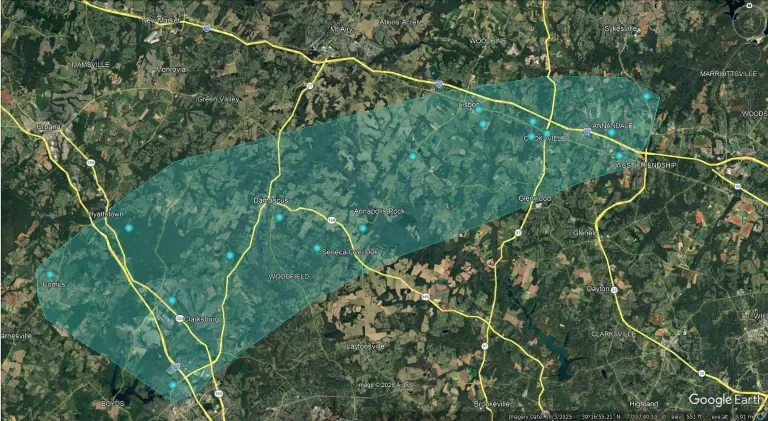
March 11th, 2026 Severe Weather Recap: 2 Tornadoes Confirmed
On March 11th of this year, widespread severe thunderstorms impacted central Maryland during the late afternoon and early evening hours, resulting in 2 tornadoes and widespread wind damage.
Cooksville Tornado
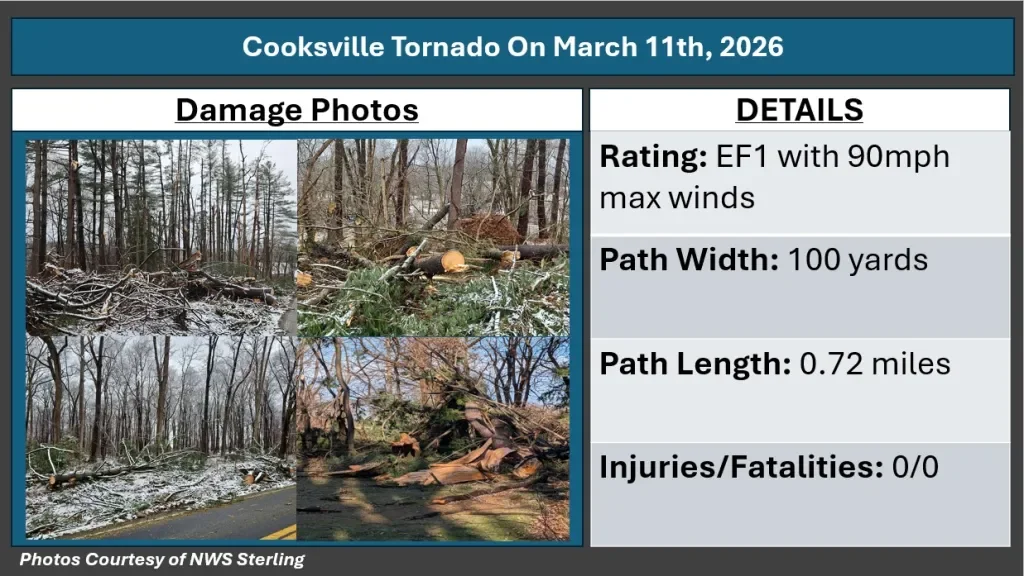
Survey Summary:

A supercell thunderstorm moved through northern Montgomery and
northwestern Howard Counties in Maryland during the evening hours
of Wednesday March 11, 2026. The bow echo and associated
downbursts/thunderstorm wind gusts caused sporadic tree damage
from 60-80mph gusts, and created a brief EF1 tornado, with focused
tornadic damage near Cooksville in northwestern Howard County.

On March 12, staff from the National Weather Service
Baltimore/Washington Weather Forecast Office conducted a ground
survey of the storm damage. The survey started near Damascus and
extended through northwestern Howard County. There were numerous
instances of trees uprooted or snapped, as well as damage
resulting from downed trees. Tree fall was generally in the
direction of the storm’s easterly movement. Ground evidence
suggested the thunderstorm produced scattered wind damage along
its path from 60 to 80 mph wind gusts.

However, as the storm continued east-northeastward, crossing the
interchange of I-70 and MD-97, damage was observed 300 yards
southwest of Old Frederick Road, crossing Old Frederick Road
between Forsythe Road and Underwood Road. Here, along a treeline
to the southwest of Old Frederick Road, approximately 50 trees
were uprooted or snapped across an approximately 100 yard wide
swath. Several of the uprooted trees fell at right angles to each
other. Additional trees were snapped or uprooted near residences
to the northeast of the road. About 300 yards to the northeast of
Old Frederick Road, and tree damage from the storm reverted to
being scattered and unidirectional. This damage is indicative of a
low-end EF1 tornado.

Additional to the ground survey, Doppler radar information from
KLWX (Sterling VA radar) and TBWI (FAA BWI radar) was analyzed.
Radar showed a powerful storm with broad rotation aloft along its
path. From radar analysis coupled with ground observations, it was
determined that an EF1 tornado formed at 7:06pm and lifted at
7:07pm, with estimated winds up to 90 mph, a path length of 0.4
miles, and a maximum width of 100 yards.
Prospect Hills Tornado
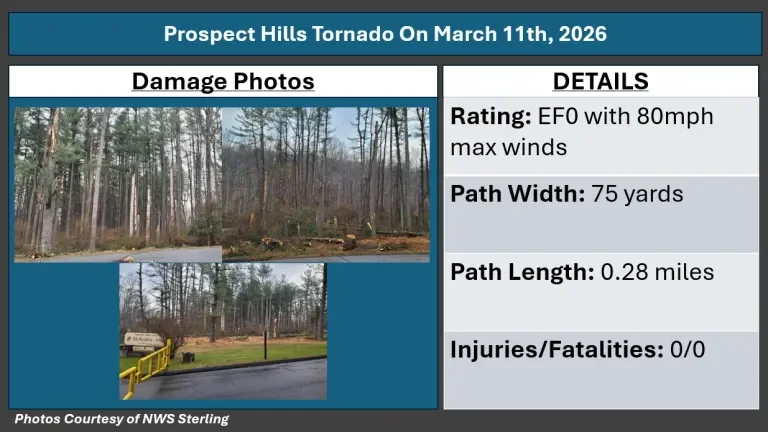
Survey Summary:

A supercell thunderstorm moved through northern Montgomery,
northwestern Howard, and southeast Carroll Counties in Maryland
during the evening hours of Wednesday March 11, 2026. The bow echo
and associated downbursts/thunderstorm wind gusts caused sporadic
tree damage from 60 to 80 mph gusts, and created both a brief EF1
tornado near Cooksville in northwestern Howard County for which
there is a previous report, and this EF0 tornado in Prospect Hills
MD, in southeastern Carroll County in the Patapsco Valley State
Park.

As the storm crossed into southeastern Carroll County, it
produced a brief tornado in Patapsco Valley State Park, with an
EF0 touching down at 7:14 pm. In the park, just east of
Marriottsville Rd, there were numerous trees uprooted and snapped.
The most intense area of tree damage was right along the entrance
drive in the McKeldin Area. Peak winds in this area were
estimated to be 80 mph. Several trees were snapped down in
multiple directions in a path up to 75 yards wide. Shortly after,
the tornado lifted at 7:15 pm and no further tornadic damage was
noted. However, sporadic wind damage in the direction of storm
motion continued to occur with the winds from the severe
thunderstorm.
Extensive straight line wind damage:
Prior to the tornadoes, a wide swath of extensive straight line winds with gusts as high as 70-90mph blew down countless trees and powerlines across western Howard, northwestern Montgomery, eastern Frederick, and western Carroll counties. Additionally, several structures sustained damage such as shingles and siding torn off, windows blown out, and barn roofs being blown off. This blocked roads due to widespread debris on roadways, and knocked out power for several days in some areas.
This just goes to show that straight line winds can be extremely impactful and produce significant damage just like a tornado.